15 October 2014

Japan Bird Festival 2014

秋はお祭りシーズン! 今年もジャパン・バード・フェスティバルに参加します。
Japan Bird Festival will be held on the 1st and 2nd of November at Teganuma lake in Abiko city, Chiba. This year, my artwork, "Bull-headed Shrike and Persimmons" is on the wildlife art exhibition's invitation postcard!


◇◆◇ ワイルドライフアート展 ◇◆◇
日本ワイルドライフアート協会会員による展示です。わたしはDMに使っていただいた「柿園のモズ」など2点を出展します。
日時:2014年11月1日(土)9:30-16:00、2日(日)9:30-15:00
場所:我孫子市生涯学習センター「アビスタ」1F。JR常磐線・成田線我孫子駅南口より徒歩10分、JBF巡回バスまたは路線バスで「アビスタ前」下車。
アビスタ入口広場のブースで作品、カードなどを販売します。

◇◆◇ ワイバードブースでの鳥グッズ販売 ◇◆◇
水の館前のワイバードブースで鳥グッズやカードを販売します。


今年のきびだんごの新顔は「翡翠団子」。
New bird juggling ball, kingfisher!


うちの中は町工場状態。休憩と称して、縫ったり、カードを切ったり、袋詰めしたりと内職する日々。


カード類も少しバリエーションアップしました。
ぜひ遊びにいらしてください! JBFの2日間とも、ワイバードブース(水の館前)又はワイルドライフアート協会の展示会場(アビスタ)にいる予定です。

13 October 2014

秋景色

It will be another month to go for the leaves to turn their colour in lowland but in the mountain, it is now the hight of autumn. 
Japanese Rowans were all red, Japanese Larches were starting to turn yellow and Nutcrackers were gathering food for the coming winter.


I struggled a lot to paint autumn colour.  In order to bring the bright yellow and red standing out, I have to put dark back ground, which means I need to concentrate on the erratic negative space made by leaves.


富士山の御中道からの大沢崩れ。
じっと座っていると、コロコロ、ザザザザザっと不気味な音がする。いまも少しずつ、少しずつ崩れているのだ。1日あたり10トン積みの大型ダンプカー28台分に相当する量の土砂が崩れているとか。不変に思える地形もこうやって密かに動いているのだと実感する。

御中道は富士講の巡拝地だったが、富士山に3回以上登った経験のある者にのみ許された最上級の修練の道だったという。それだけやはりこの大沢崩れなどを渡るのは危険だったのだろうか。


I was enjoying the Christmas tree game.  Here is a Nutcracker already hiding a Christmas present!
御中道は浸食谷をいくつも渡るので、大小さまざまなカラマツのクリスマスツリーがいっぱい見られる。ホシガラスはもうすでにプレゼントを隠していた。
(わたしのクリスマスツリーの絵本「Weihnachtsspuren im Winterwald」はようやく紀伊国屋、Amazonで販売を開始したらしいです!!)

ホシガラスは秋、その冬を乗り越えられるための何万個もの種子を隠すのに忙しいときは、脳の海馬領域が拡大するのだそうだ。でも春になりほかの食糧が手に入るようになると海馬は縮小して、種子の場所を忘れてしまうという。(「世界一賢い鳥、カラスの科学」より)
「カラスの科学」を訳した母は、すでにこのエピソードがどこに書かれているのか、すっかり忘れてしまっていた。どうやら一冊訳し終えると、その本のための海馬が縮小してしまうらしい。ホシガラス並みの記憶力!?


Cowberries, lichen and larch seedlings.
I imagined the tiny children with Fly Agaric caps from the picture book, "Children of the Forest" by Elsa Beskow running about while I was painting this.

6 October 2014

Hawk Migration

One thing I missed about Japan while I was in England was autumn hawk migration.  Looking up the vast sky for all day long and sending off the amazing number of hawks heading south is one best way to feel the season.
This year I had chances to visit two hawk watch points, Shirakabatoge mountain pass in Nagano prefecture and Iragomisaki point in Aichi prefecture.


白樺峠にて。あまりに何も飛ばないので、山際に目をこらすのに疲れてきた夕方。16時15分に引き上げましょうと決めたので、一人、二人と先に下山し始めた。そして16時14分、にわかに8羽のタカ柱ができて南西へと流れていった。やっぱり最後まで諦めないことは肝心らしい!


ハチクマ(Oriental Honey-buzzard)
In Japan, the main migrating hawks are the oriental honey-buzzard and the grey-faced buzzard.


みんなが飽きるまでポーズをとってくれたサメビタキ(Dark-sided flycatcher)Little birds also migrate.


伊良湖岬。初日は快晴だったのに南風が強かったせいか、ぜんぜんタカが飛ばなかった。でもビューホテルからのサンセットは美しかった。


タカが出なくても、屋上から渥美半島、神島、答志島、紀伊半島へと続く地形を眺めると、渡るタカの気分が味わえて幸せ。


伊良湖での唯一のハイライト、近くを飛んだチゴハヤブサ。
Trying to catch a fast flyer, the hobby.

27 September 2014

The Mumsnet book of Animal Stories

I finally received a copy of the Mumsnet book of Animal Stories, an anthology of ten prize-winning short stories, which has some of my illustrations from earlier this year! 


The Mumsnet book of Animal Stories
will be published by Walker Books on the 2nd October.
The cover illustration is by Briony May Smith.


わたしがイラストを6点描かせてもらった本の見本が届いた! 
イギリスのお母さんたちが書いた子どものための動物の短編集で、コンペティションに入選した10作品をまとめたものだ。10人の新人イラストレーターがそれぞれの作品に絵を添えている。わたしがイラストを描いたのは、Alison Webb氏によるハリネズミの子どものお話。彼はお母さんが冬眠してしまったあとも、まだ眠る気になれず、森へと冬を探しに出かけていく。
10月2日にWalker Booksから出版される。日本のアマゾンでも取り扱っているようです。簡単なお話なので、英語の勉強にいかがですか?!


The book includes different type of stories about many kinds of animals from a lion and elephants to meerkats and bats. The story I made illustrations for is "The Hedgehog Who Wouldn't Sleep" by Alison Webb.  It is based in nature and all the animals in the story are wild ones.  So it was really a story for me!      


A sneak preview of one of the spreads!

In the story, there is a scene of Little Spike, the hedgehog boy, rolls down a hill and be covered with snow and hits the tree trunk.  I couldn't imagine how it would look like...
So I found my hedgehog, a spiky bur of Japanese chestnut!  Luckily, it snowed heavily while I was working on the project in February.  I made a snow ball with the bur in it and throw it to hit a wall.


And here you are, poor Little Spike covered with snow!!


I only had a month to make all the illustrations and since mine was in printmaking method, it was very hard. Worrying about me working until very late at night, my sweet mother made these cute hedgehogs to encourage me!  One went to my grandma's place but the left one is with me still:) 
イラストを描くためにハリネズミのことを調べていたら出てきた手芸サイトの型紙を使って、母がこんなのを作ってくれた。

18 September 2014

Autumn in the Air


ノウタケ
まだ若く皺のない脳。割った中が白いうちは食べられるらしい。持って帰ればよかった!


アキノギンリョウソウ(Indian Pipes)
"Tis whiter than an Indian Pipe"
by Emily Dickinson 

I have just learned from my friend that Indian Pipe was "the preferred flower of life" for Emily Dickinson, an American poet from 19th century. The book cover of her "poems" has a beautiful watercolour painting of this flower by her neighbor, Mabel Todd.


カヤキリ (Pseudorhynchus japonicus)
鳴く虫の声は気にしていないかぎり聞こえてこないけれど、耳がなれてくると、すてきなオーケストラ。


カゴカキダイ(左)とオヤビッチャ(右)
波が岩にぶつかり水中に泡を送り込んでいる部分にオヤビッチャがたくさんいた。


カワハギ

12 September 2014

Fish Watching at Miyakejima

The last day at Mikurajima Island was a beautiful sunny day. We sailed to Miyakejima, the volcanic island about an hour away by ferry.


三宅島へ。


Although Miyakejima is a famous island for birdwatching because of its endemic species, we spent most of the time in the sea. Early September is not a good time for watching birds.

I tried to sketch a lot with a snorkel and learn about beautiful fishes.  Everything under water was new to me!  

富賀浜のテーブルサンゴとツノダシ。このテーブル状になる造礁サンゴはミドリイシ属らしい。
Moorish idols at Togahama beach, where table corals grow.   


チョウチョウウオ、タカハノダイ(左)。ゴイシウミヘビとオヤビッチャ(右)。
タカハノダイの尾びれの水玉模様がすてきだ。
The YUPO paper I use for sketching underwater is really great but it has one big problem.  I can not use watercolour with it while the scenery in the water is such a perfect subject for painting with brush and lots of water.

But I came up with a brilliant idea!  I simply copied the drawing onto a piece of watercolour paper.  I only have a inkjet printer so I had to trace a few lines with a pencil.  But it seems to be working well so far.  It was actually what Ruchi was doing when she had to practice colouring for several times for one perfect piece.  


By copying the original sketches instead of drawing them again on white paper, I feel that I can keep the freshness of the sketches.  The beauty and the importance of sketching in the field is, I think, capturing the scene and movement fresh.  A work from the field somehow has the atmosphere and character that often disappears when we make a fine final work in the studio.     


三宅島2日目は、1、2年前から島に住んでいる友達が土方海岸に連れて行ってくれて、いろいろ教えてくれた。わたしの見たままに描いたスケッチを見て、上のチョウチョウウオは成魚で、下のは幼魚だね、と彼女。背びれの後ろの端に黒い斑があるのが幼魚らしい。タカラガイの仲間も見つけてくれた(右の絵の下)。シュノーケリングでのスケッチは、波に少しずつ流されて自分の位置が変わってしまうので難しい!


水面すれすれのところをオキザヨリが泳いでいた。下ではアオヤガラがじっとしている。


最後はおしゃれなミサキカフェでお昼ご飯。11時半の開店を待つ間、沖原海岸から海を眺めた。アオウミガメがときおり顔を出す。バックには珍しく雲のかかっていない御蔵島。 すてきな時間をありがとう!

9 September 2014

カツオドリの降る島

At night from Mikurajima Island, you can see hundreds of shooting stars...no shooting shearwaters. Streaked Shearwaters come back to the island, where they breed, after dark and they fly above the island underneath the real stars.


御蔵島のカツオドリとはオオミズナギドリのことだ。夜になると巣のある島に戻ってくる。海上でダイナミックソアリングをしている優雅な姿からは想像できないほど、地上ではどんくさくて、ときには集落の道路にも文字通り「降って」くる。真っ暗闇でお腹の白が目立つ。


A few hours before dawn, we set off to see the shearwaters taking off for the day's feeding. It seemed that they were everywhere on the island. Some were even sitting on the road in the village. 
We knew we were getting closer to their colony area because the forest was full of their calls and wing flapping sounds and occasional thump!  They were very clumsy on land and quite often fell on the road.  


真っ暗闇で雨が降る中、夢中でスケッチしたのでノートの上下もよくわからず。彼らは暗い森から開けた海へと飛び立つために、明るいところに向かおうとするのか、手持ちのライトをめがけて突っ込んでくることも!


After feeding their incubating partners or chicks in the nest hole or switching the parent duty, they take off from the island before the daybreak.


With their long and narrow wings, they can not start flying easily from the land.  So they were trying to gain some height to jump off and pick the air.  With the webbed feet and beak and a bit of wing flapping, they really can climb steep slopes and trees!


They seemed to be just flying blindly to the sky and the sea, which look slightly lighter than where trees grow. Quite often they were caught by branches and struggling to get out from there. Many of them were also trotting down the steep road, using it as a runway. I wonder what they were doing before people built the road.


本当に木登りをして飛び立っていった!

After five o'clock, I suddenly realised that the sky was getting lighter and the forest became quiet and empty.  There was no sign of the clumsy birds any more.  They were all gone to the sea.  
Morning had come.  


昼になって森を歩き、オオミズナギドリの卵の殻を見つけた。鶏の卵と同じくらいの大きさだった。

8 September 2014

World Shorebirds' Day Sketching Project

Last weekend was the World Shorebirds' Day. I heard from Eriko Kobayashi, a Japanese wildlife illustrator and artist, that there was also a sketching project for artists on these two days. So I went to my local coast on Saturday and Yatsuhigata mudflat (Ramsar site near Tokyo) on Sunday to sketch some waders!
世界各地でシギ・チドリのカウント調査をしようという日、World Shorebirds' Day(9月6日、7日)に合わせて、シギ・チドリのスケッチをしてきた。この二日間に、世界中のアーティストが各地でシギ・チドリをスケッチし、その絵をweb上共有するというプロジェクトがあり、ぜひ参加してみたいと思ったのだ。


チュウシャクシギ
A whimbrel at a rocky shore. He or she was the only wader around there...


横浜市唯一の自然海岸、平潟湾のキアシシギ。ほんの一区画しかない干潟に鳥よりも潮干狩りの人のほうが何倍も多くいる。
Grey-tailed Tattlers


谷津干潟のセイタカシギ。頭が茶色っぽい幼鳥だった。
Black-winger Stilts
On Sunday, even though it was rather a wet day, I visited Yatsuhigata mudflat in Tokyo Bay.  It turned out to be very good because I observed quite a lot of waders such as Red-necked Stints, Long-toed Stints, a Sharp-tailed Sandpiper, a Red-necked Phalarope, Grey Plovers, Ruffs, March Sandpipers, Terek Sandpipers, Grey-tailed Tattlers, Lesser Sand Plovers and a Ringed Plover.


ソリハシシギ(上)とアカエリヒレアシシギ(下)
Terek Sandpiper (above) and Red-necked Phalarope (below)!  I was very pleased to be able to watch the phalarope for a long time.


ちょっとアカエリヒレアシシギを大きく描きすぎたかも!


ヒバリシギ(Long-toed Stint)
ヒヨ吉さんにヒバリシギ、ウズラシギの見分けをいろいろ教えていただいた。なんとなくトウネンでないのはわかっても、この手のシギの識別はどうしても自信が持てない。
下はエリマキシギ。幼鳥はこんなに黄色っぽい茶色なんだ!

久しぶりにシギ・チドリをじっくり観察し、よい勉強になった。こういう機会を与えてくださった主催者のGyörgy Szimuly氏、ハンガリーのワイルドライフアーティストSzabolcs Kokay氏とプロジェクトを紹介してくださった小林絵里子氏に大感謝!
世界各地から、どんなシギ・チドリの絵が集まっているのか楽しみだ。

6 September 2014

Trying to Sketch Dolphins

At Mikurajima Island, I swam with wild dolphins!
There are population of Indo-Pacific Bottlenose Dolphins living around the island throughout the year. Quite a few individuals are identified and named since 1994.  So people now know who is staying in the area and who is whose son or daughter.


When they are in playful mood, they really come close to you.  One came to see me floating at the surface.   I could have touched him/her.


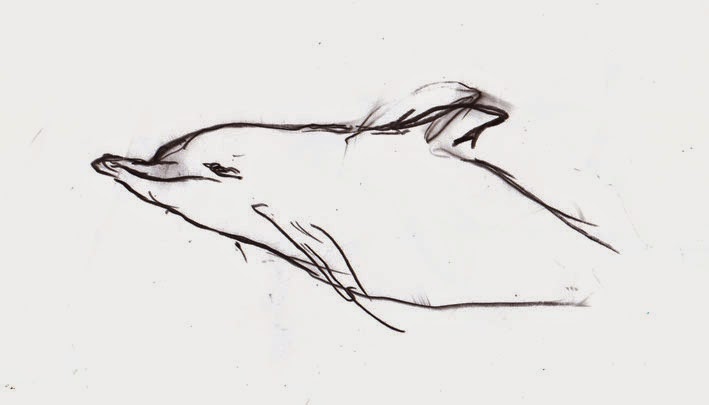
I know that it is a bit crazy but I tried sketching them in the water.  I used YUPO paper made of polypropylene, which I can write and draw with pencil in the water.


ユポ紙のノートを使って水中スケッチにチャレンジ。水の中では屈折率が違うせいか、波に揺れているせいか、頭で描いた線がなかなか紙の上に引けない。でもその分、もうちょっと練習すれば味のある線が描けるような気もする。ユポ紙のノートは丸ごと水中に持ち込んでも全く破れず使いやすかった。シュノーケルの基本とともに、もっともっとトレーニングが必要だけれど・・・。


Rainfall on Mikurajima gets together as a rapid stream and goes into the sea as a waterfall. Since we had very wet days, we could see a good volume of waterfalls.


After loosing sight of a pod of dolphins, I found a Green Turtle!  
海と陸とをつないできた はるかな命よ!